Blog
Blog



PRIVO didn’t begin with a grand plan to launch a privacy company.
It began with a problem.
In 2000, PRIVO Co-founder/CEO Denise Tayloe found herself challenged to address the newly enacted Children’s Online Privacy Protection Act (COPPA) requirements while developing the execution plan for a minors’ digital marketing service she was exploring with her brother, Ken Tayloe, to engage kids online by letting them share their ideas. Complying with it wasn’t simple. There were no templates. No technology providers. No operational roadmap for how to obtain verifiable parental consent or manage minors’ digital identity in a defensible way.
Rather than work around the problem, Denise leaned into it. In solving for their own compliance challenge, a bigger opportunity emerged: what if infrastructure existed specifically to help companies responsibly engage with children and families?
That spark became PRIVO.
Building Before There Was a Market
In the early 2000s, after the dot-com bubble imploded, the internet looked very different.
Children accessed the web through shared desktop computers. Dial-up connections and AOL were common. Flash-powered websites defined online experiences. Smartphones, smart homes, and always-on personal devices were still years away. Minors’ privacy compliance was largely misunderstood. Companies struggled to interpret COPPA’s requirements, let alone operationalize them in a scalable way.
PRIVO stepped into that uncertainty.
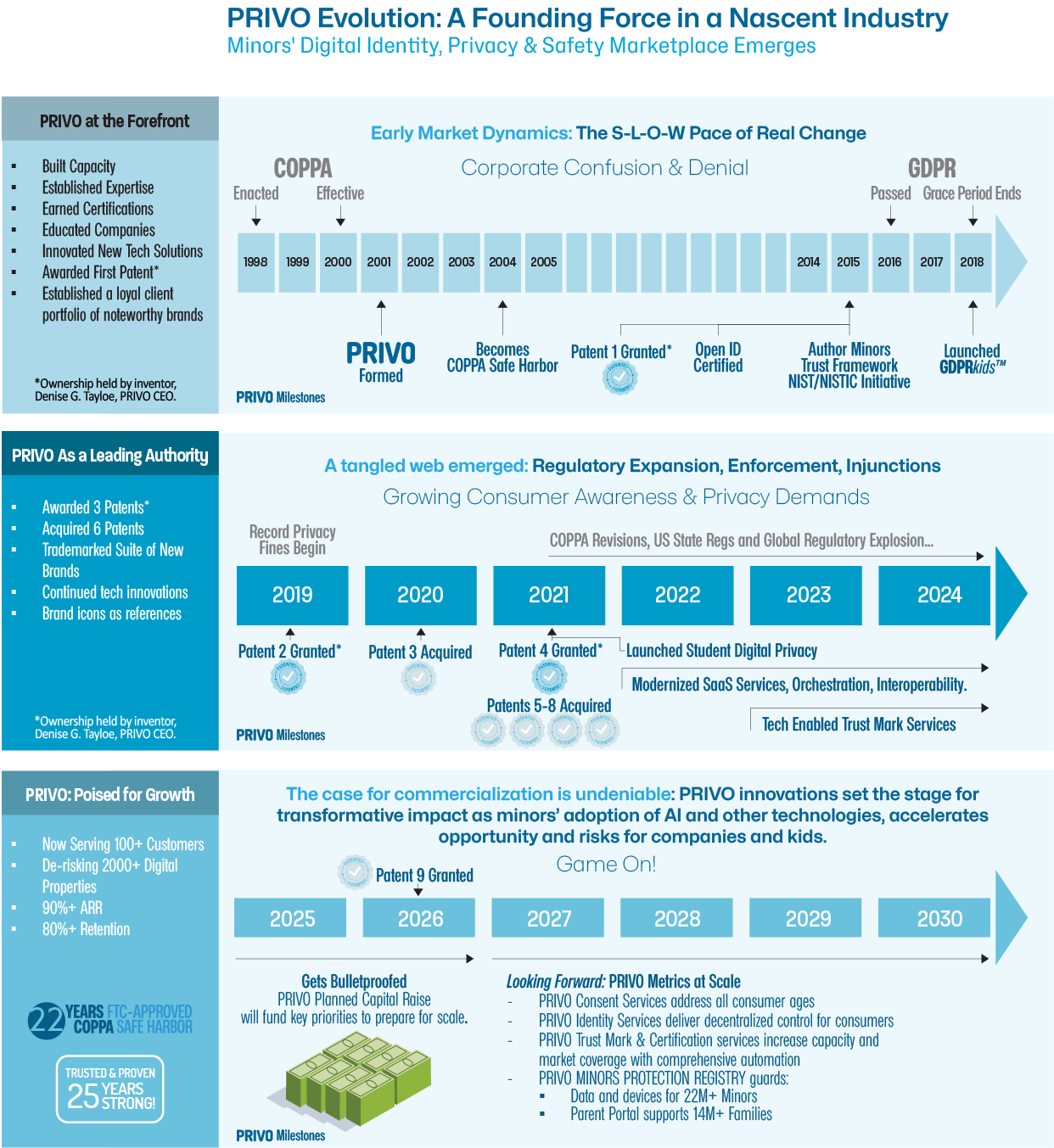
In 2004, PRIVO was approved as an FTC-authorized COPPA Safe Harbor — one of the earliest organizations entrusted with helping companies meet federal children’s privacy requirements. That approval included the PRIVO-Lock System, now known as the PRIVO ID Platform — a suite of offline and online identity authentication methods designed to enable verifiable parental permission. At a time when digital identity verification was still emerging, PRIVO built defensible systems that allowed companies to confidently activate accounts and compliantly engage with minors.
(See the original FTC announcement here →)
This was more than policy interpretation. It was the creation of practical consent and age verification infrastructure years before the broader market demanded it. PRIVO continued to innovate — building universal consent services, expanding globally, authoring the Minors Trust Framework, and securing and leveraging patents protecting minors’ identity systems.
Long before age verification became headline news, PRIVO was engineering systems for it.
Staying the Course When Others Didn’t
The journey was not without skepticism. Around 2010, while raising capital, PRIVO was told: “No company will ever care enough about protecting children’s privacy online to pay for your service.”
At the time, children’s privacy was often viewed as niche. Some companies minimized their exposure. Others chose to wait for enforcement before investing in solutions.
PRIVO did not wait.
Instead, the company doubled down on building scalable, interoperable identity infrastructure. In 2013, PRIVO was awarded a $3.2 million grant under the National Strategy for Trusted Identities in Cyberspace (NSTIC) Pilot Grant program — a White House initiative designed to advance secure digital identity solutions.
The grant supported the development of a secure, interoperable identity framework enabling parents to manage their children’s online privacy and comply with COPPA in a scalable, user-centric way.
This was a pivotal moment. It validated the importance of trusted digital identity infrastructure and accelerated PRIVO’s technology development at a time when the broader market was still catching up. While some debated whether children’s privacy would matter commercially, PRIVO was building the identity and consent architecture that would eventually become foundational.
The Companies Who Chose to Lead
Over the years, some companies chose to wait.
Others chose to lead.
We are proud to work with organizations — some of whom have partnered with PRIVO for more than a decade — that understood early on that protecting children was not just about avoiding fines. It was about building trust.
Collectively, PRIVO’s members help protect the privacy of billions of minors across more than 230 countries and territories worldwide.
They represent every part of the digital ecosystem — entertainment and gaming, education, retail, ad tech, toys, emerging technologies, and health and wellness. They open their doors for review, evaluation, and improvement. They invest in infrastructure. They implement age verification and consent systems before they are required to.
Together, these organizations have helped set new benchmarks for responsible innovation and digital trust. Explore our Discovery Platform showcasing some of our members→
The World Changed — Dramatically
Over 25 years, digital engagement transformed. Static websites evolved into app ecosystems, gaming platforms, social networks, creator economies, connected devices, and AI-powered systems capable of personalization and inference at scale.
Children no longer gather around a shared computer. They carry personal devices. They learn, play, socialize, and increasingly interact with AI-enabled environments. At the same time, data collection, profiling, and monetization models became more sophisticated. Automated decision-making reshaped digital experiences — and the risks associated with them.
Regulation followed.
Age verification is no longer theoretical. It is mandated. From U.S. state-level laws to global regulations, companies can no longer overlook the presence of minors on their platforms. Age assurance and verifiable parental consent are becoming embedded expectations — not optional safeguards.
The infrastructure PRIVO began building in the early 2000s is now central to responsible digital operations.
What 25 Years Has Reinforced
Responsibility should not wait for enforcement. Children’s privacy is not a niche concern. It is a foundational design requirement in an interconnected, AI-enabled world.
As technology becomes more immersive, personalized, and predictive, the importance of verified age signals, defensible consent mechanisms, and trusted identity frameworks only increases.
What once felt ahead of its time now feels essential.
Gratitude — and the Road Ahead
This milestone belongs to the PRIVO team — past and present — who built through uncertainty, collaborated across industries, and committed to protecting children even when the commercial incentives were unclear.
It belongs to the clients who chose to lead rather than wait.
And it belongs to the broader ecosystem that now recognizes what PRIVO believed from the beginning: protecting minors in digital environments is not optional.
It is structural.
The tools have evolved.
The laws have expanded.
The technology has accelerated.
The mission remains steady.
Here’s to the next 25 years of leading children’s privacy.



 Facebook
 Twitter
 Linkedin
 Blog
Blog Newsletter


 Twitter